Quick answer
Five technologies are changing how final cleans get done: autonomous floor scrubbers for large floor areas, HEPA filtration for the fine dust you can’t see, electrostatic sprayers for even sanitising of complex surfaces, laser ablation for stripping residue without damaging what’s underneath, and digital management software for documented, auditable quality control. Together they make a handover clean faster, safer and provable — rather than just visually tidy.
The dust has settled, the last nail is hammered, and the final coat of paint has dried. But before a project can be handed over, one monumental task remains: the final clean. This isn’t your average spring cleaning — it’s a battle against layers of plasterboard dust, stubborn paint splatter and fine particles that seem to defy gravity. For too long it’s been a slow, manual grind, but advances in construction cleaning technology are changing that fast.
The broom and dustpan are making way for tools that tackle the biggest post-construction problems with precision. From autonomous robots navigating vast floors to lasers that strip paint overspray without a trace, these innovations make final cleans faster, safer and more effective — and not just visually clean, but genuinely healthier spaces. If you want a deep clean that goes beyond the basics, take a look at our building and construction cleaning service.
Here are five technologies taking post-construction cleaning far beyond the broom.
1. Autonomous Floor Scrubbers
The single largest surface on any site is the floor, and it’s usually the dirtiest. Manually scrubbing large floor areas is slow, labour-intensive work that can throw the very dust you’re trying to capture back into the air. Autonomous mobile robots — robotic floor scrubbers from makers like Tennant, Kärcher and Avidbots — now do this work on their own, using LiDAR and 3D sensors to map a space, avoid obstacles and clean far more consistently than manual methods.
That frees human crews for the detailed, high-value tasks — sanitising bathrooms, polishing fixtures, detailing glass — while the robot delivers an even, reliable clean across the whole floor plate. On a large commercial job that shift alone can take a meaningful bite out of the total man-hours a builders clean requires.

2. HEPA Filtration
One of the biggest health hazards on a site is the fine, respirable dust from plasterboard, concrete and timber. These microscopic particles linger in the air for days, infiltrate air-conditioning systems and pose serious long-term health risks. HEPA (high-efficiency particulate air) filtration is the standard for capturing them: a true HEPA filter traps 99.97% of airborne particles as small as 0.3 microns.
On site it shows up in two forms — industrial air scrubbers that continuously draw in contaminated air and exhaust it clean, and H-class HEPA vacuums that trap the finest particles instead of blowing them back into the room. Together they dramatically improve indoor air quality, which matters most in sensitive environments like hospitals and schools. It’s also a compliance issue, not just a comfort one: see the health risks on a “clean” site for the Australian exposure standards that apply.

3. Electrostatic Sprayers
A final clean isn’t complete until high-touch areas in kitchens and bathrooms are properly sanitised, and traditional spray-and-wipe is slow and often misses the backs and undersides of surfaces. Electrostatic sprayers give each disinfectant droplet a positive electrical charge as it leaves the nozzle; because most surfaces carry a neutral or negative charge, the droplets wrap right around objects for a complete, 360-degree coating.
It’s faster than manual application, uses less chemical, and coats complex objects like taps, toilets and door handles evenly — a level of consistency that’s hard to achieve by hand.

4. Laser Ablation
Sometimes the problem isn’t dust but stubborn material in the wrong place — paint overspray on brick, rust on metal fixtures, or cement residue on new frames. Traditional fixes like chemical stripping or sandblasting are messy and risk damaging the surface underneath. Laser cleaning, or ablation, uses a focused beam of light to vaporise contaminants: the energy is absorbed by the rust, paint or grime, which turns to gas and lifts away, leaving the material beneath untouched.
It’s a non-contact, chemical-free method that allows precise, almost surgical removal of residue from delicate or high-value surfaces. That makes it valuable for restoration work and for the kind of bonded residue that’s otherwise among the hardest messes to remove from a site.

5. Digital Management Software
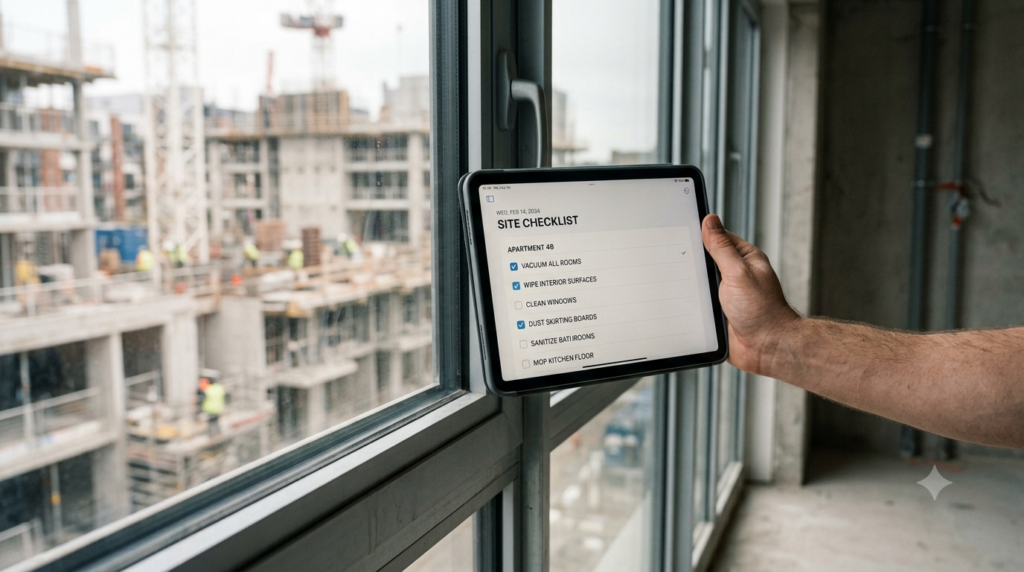
Managing a final clean has traditionally meant paper checklists, phone calls and very little transparency — a recipe for missed tasks and disputes over quality. Cloud-based cleaning and construction-management platforms like Jobber and Janitorial Manager bring it into the digital age. Crews follow digital checklists, log issues with time-stamped photos and track their hours on a mobile app, while managers monitor progress in real time and clients receive reports and sign off digitally.
The result is documented quality control rather than a matter of memory — which protects both sides if something is queried at walkthrough. The same shift toward measured rather than estimated work is what makes it possible to quote a builders clean accurately from plans and photos.
The Future Is Clean and Smart
The shift to construction cleaning technology marks a move from a labour-based service to a technology-driven one. These tools aren’t just about cleaning better — they’re about working smarter, safer and more efficiently, and delivering a result that’s both visually pristine and demonstrably healthy. By combining automation, advanced filtration and documented management, a crew can hand over a site that looks and feels genuinely finished.
Worth being clear-eyed about it too: none of this replaces method or sequencing. A robot scrubber on a site where the trades haven’t finished still cleans a floor that’s about to get dirty again. The technology multiplies a good process — it doesn’t substitute for one.
Frequently Asked Questions
Autonomous floor scrubbers for large floor areas, HEPA filtration for fine respirable dust, electrostatic sprayers for even sanitising, laser ablation for stripping bonded residue, and digital management software for documented quality control.
On large, open floor plates, yes — they use LiDAR and 3D sensors to map a space and clean consistently, freeing the crew for detail work. They’re less useful on small or cluttered residential jobs.
Because construction dust contains respirable crystalline silica, and ordinary vacuums push the finest particles back into the air. A true HEPA filter traps 99.97% of particles as small as 0.3 microns.
Removing bonded residue — paint overspray, rust, cement — from delicate or high-value surfaces. It’s non-contact and chemical-free, so it lifts the contaminant without damaging the material underneath.
Not automatically. On large commercial jobs automation can reduce labour hours, but the bigger gains are consistency and documented proof of the work. Technology multiplies a good process — it doesn’t replace correct sequencing.
Ready for a smarter handover clean?
Spruces handles builders cleans and final cleans Australia-wide, from the Gold Coast and Brisbane to Sydney and Melbourne. Send your floor plans, a few site photos and your handover date to finalclean@spruces.co, or call +61 489 937 600, and we’ll come back with a fixed, itemised price.