Quick answer
From 1 December 2026, Australia’s workplace exposure standards (WES) become workplace exposure limits (WEL). For respirable crystalline silica the number doesn’t move — it stays at 0.05 mg/m³ over an eight-hour average — but the wording change is deliberate: a limit is something you must not exceed, not a target to aim at. A further cut to 0.025 mg/m³ has been proposed and is still pending. None of this changes the silica duties that have already applied since September 2024.
Most of the coverage of this change is written for safety managers. This one is written for builders, and specifically for the part of the job where silica exposure is easiest to overlook: the final clean.
What changes on 1 December 2026
Safe Work Australia is replacing the workplace exposure standards list with a workplace exposure limits list, adopted nationally. WHS ministers agreed to the rename to make the intent unambiguous — these are limits that must not be exceeded, and the terminology now lines up with international practice (Safe Work Australia).
For silica specifically, the practical positi4on is this:
- The number is unchanged — 0.05 mg/m³, eight-hour time-weighted average.
- The legal framing tightens. “Standard” invited debate about what was reasonably achievable. “Limit” doesn’t.
- Documentation matters more. If your close-out paperwork is thin now, it will be more exposed under a limit-based framework.
The full list of limits is published on the Safe Work Australia airborne contaminants page.
The proposed reduction to 0.025 — and why you shouldn’t plan around it yet
Safe Work Australia has proposed halving the silica limit again, from 0.05 to 0.025 mg/m³. Silica is one of nine substances where WHS ministers asked for further impact analysis before the value is finalised, so the decision is still pending.
Two things follow from that. It is not law, and anyone telling you the limit is dropping in December is ahead of the evidence. But the direction of travel is unmistakable, and if you’re writing cleaning scopes or buying dust-control equipment for projects completing in 2027 and beyond, specifying to the tighter figure now is cheap insurance.
What has already changed — and often gets missed
This is the part worth reading twice, because it’s already in force. Since 1 September 2024, dedicated silica duties have applied to processing materials containing 1% or more crystalline silica. In practice that means:
- A silica risk assessment before the work starts
- A written silica risk control plan
- Training for workers who may be exposed
- Air monitoring where exposure is uncertain
- Health monitoring for workers at risk
None of that changes on 1 December. If those duties aren’t already running on your projects, the December transition isn’t your first problem — it’s your second.
This is general information about how the framework is changing, not legal advice. For anything contentious, get your WHS adviser across it.
Why this lands hardest on the final clean
Silica controls get most attention where the dust is created — cutting, grinding, chasing, drilling. That’s correct, but it leaves a blind spot at the other end of the job.
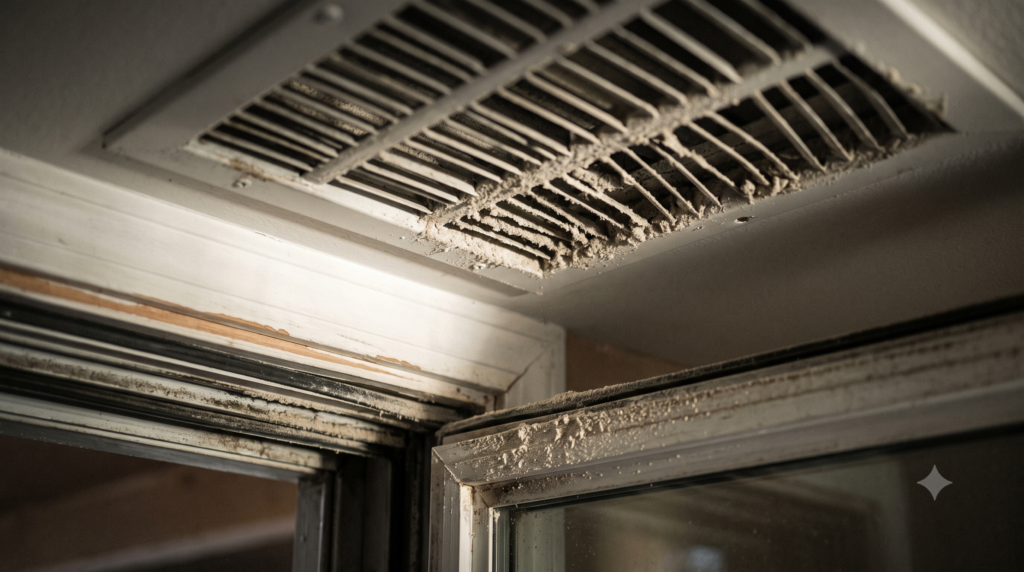
By handover, the silica generated over months of construction hasn’t left the building. It has settled — into vents, ceiling voids, window tracks, carpet underlay, the tops of doors and inside joinery. And cleaning is, by definition, the activity that disturbs it and puts it back into the air.
Three things make this the weak point on most sites:
- It’s often the last high-exposure task, performed once the trades who owned the silica plan have left.
- It’s frequently subcontracted to whoever is cheapest, with the least scrutiny of their controls.
- Domestic equipment makes it worse. A household vacuum passes the finest, most dangerous particles straight through the exhaust and back into the room.
Your cleaning contractor is a PCBU in their own right, with their own duties. But the exposure happens in your building, and the documentation lands in your close-out pack. We go deeper on the physical controls in the health risks on a “clean” site.
What to require from your cleaning contractor
Put these in the scope rather than assuming them. Any competent post-construction cleaner will meet them without argument:
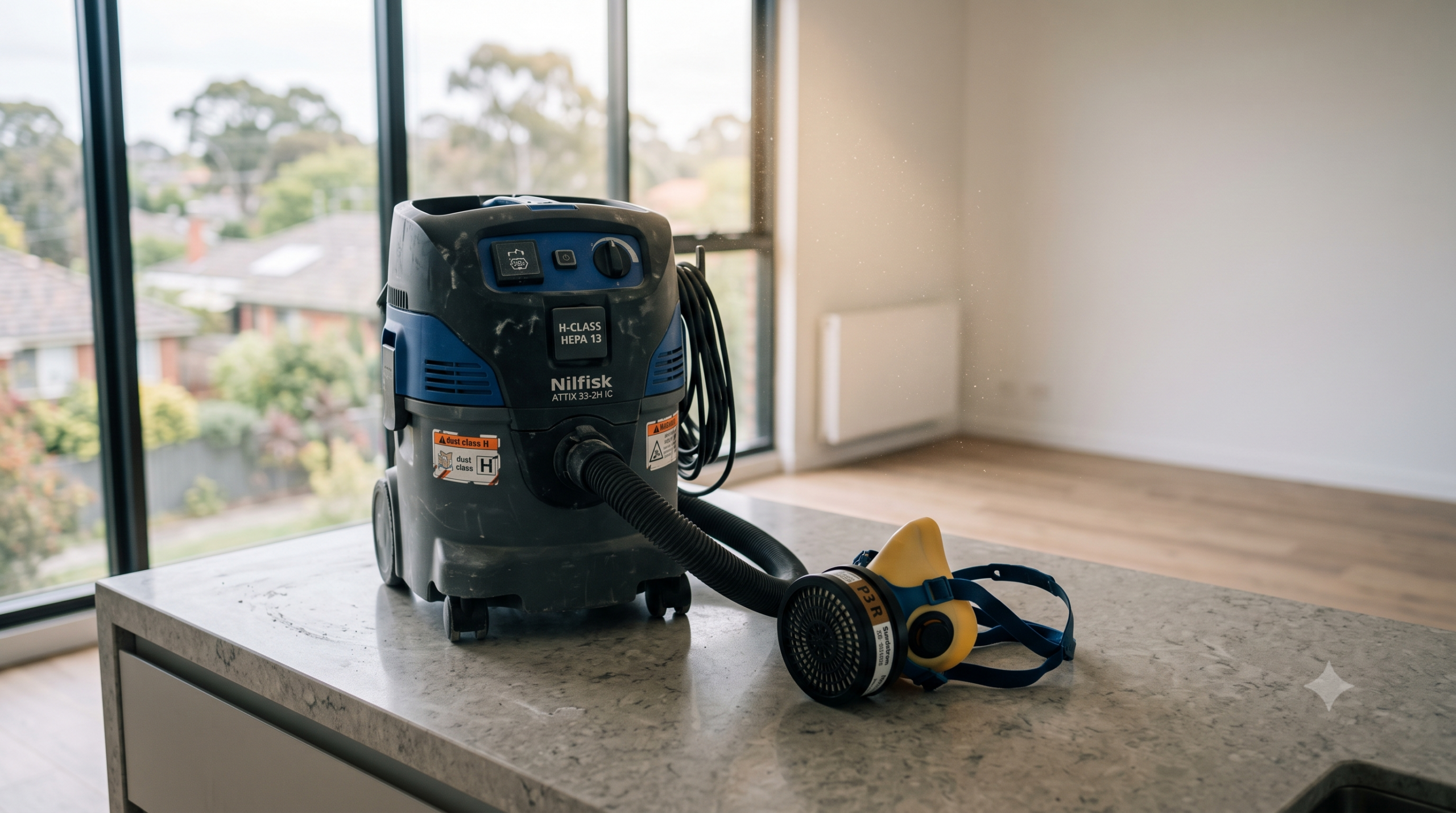
- H-class HEPA extraction — not “a HEPA-labelled vacuum”, and never a domestic unit.
- Wet methods over dry. Damp-wiping instead of dry dusting, and no dry sweeping anywhere silica may be present.
- Fit-tested respiratory protection, worn through clean-down and waste handling, not just the noisy work.
- Air scrubbing and purge before the space is handed over or the air conditioning is commissioned.
- Controlled filter changes and waste disposal, so what was captured doesn’t get re-released.
- Written evidence at sign-off — what controls were used, where, and by whom.
Attaching a checklist to the scope is the simplest way to make the standard explicit — ours is here.
A short list for before December
- Check your silica risk control plan actually covers the cleaning and handover phase, not just cutting and grinding.
- Ask your cleaning contractor what extraction class they use. If the answer isn’t H-class, that’s your answer.
- Add a dust-control line item to your close-out checklist, so evidence is collected as you go rather than reconstructed later.
- Stop the air conditioning being commissioned before the final clean is finished — it redistributes settled silica through the whole building.
- For anything completing in 2027, specify against 0.025 mg/m³ even though it isn’t law yet.

Frequently Asked Questions
Australia’s workplace exposure standards (WES) become workplace exposure limits (WEL), adopted nationally. The rename signals that these are limits not to be exceeded, and aligns Australia with international terminology.
Not yet. Safe Work Australia has proposed halving it from 0.05, but silica is one of nine substances where ministers requested further impact analysis, so the decision is still pending. It is not law.
No. The duties that have applied since 1 September 2024 — risk assessment, silica risk control plan, training, air monitoring and health monitoring — continue unchanged.
Because months of construction silica has settled into vents, tracks, voids and joinery, and cleaning is the activity that disturbs it. It’s often the last high-exposure task on site, done after the trades who owned the silica plan have left.
H-class HEPA extraction (never a domestic vacuum), wet methods over dry sweeping, fit-tested respirators, air scrubbing before handover, controlled filter changes, and written evidence of the controls used.
Handover cleaning that stands up to scrutiny
Spruces runs H-class HEPA extraction, wet methods and air scrubbing as standard on builders cleans and final cleans, Australia-wide — from the Gold Coast and Brisbane to Sydney and Melbourne.
Send your floor plans, a few site photos and your handover date to finalclean@spruces.co, or call +61 489 937 600, and we’ll come back with a fixed, itemised price. No site visit needed.
References
- Safe Work Australia — New workplace exposure limits apply from 1 December 2026
- Safe Work Australia — Workplace exposure limits for airborne contaminants
- Safe Work Australia — Crystalline silica and silicosis